

Comparison between Indian qualified Doctors and MBBS/MD from Foreign universities
A key difference between Indian-qualified doctors and those who studied abroad is the path to licensure and professional practice in India. While Indian graduates are already qualified to practice after completing their MBBS and internship, foreign medical graduates (FMGs) must clear a mandatory licensing exam to get their license.
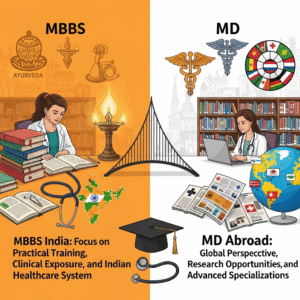
The Path to Practice in India
- For Indian Graduates: After successfully completing the 4.5-year MBBS course and a mandatory 1-year rotational internship, Indian graduates are eligible to register with the National Medical Commission (NMC) or a State Medical Council. This registration allows them to practice medicine independently in India.
- For Foreign Graduates: FMGs who hold a primary medical qualification from an NMC-recognized university abroad must pass the National Exit Test (NExT). NExT is a new unified exam for both Indian and foreign-trained students for licensure and postgraduate admissions. Prior to NExT, FMGs had to clear the Foreign Medical Graduate Examination (FMGE). The passing rate for these exams has historically been low, making this a significant hurdle.
Curriculum and Clinical Exposure
The quality and structure of the medical curriculum and clinical exposure can differ significantly between Indian and foreign universities.
- Indian Universities: The Indian MBBS curriculum is generally uniform and regulated by the NMC. It follows a structured approach with distinct phases: preclinical, paraclinical, and clinical. Students get extensive clinical exposure in large government or private hospitals, treating a high volume of patients. This provides hands-on experience with diseases and conditions prevalent in India.
- Foreign Universities: The curriculum abroad varies widely by country and university.
- Eastern Europe and Central Asia: Many universities in this region follow a curriculum similar to the Indian model, often with a focus on theoretical knowledge in the initial years.
- Western Countries (US/UK): Countries like the U.S. and U.K. have a different system. Medicine is a graduate-level course (MD) following a bachelor’s degree. Their curriculum often emphasizes integrated learning and early clinical exposure, with students beginning rotations and patient interaction much earlier.
- Eastern Europe and Central Asia: Many universities in this region follow a curriculum similar to the Indian model, often with a focus on theoretical knowledge in the initial years.
Cost and Competition
Cost and competition are major drivers for Indian students to pursue MBBS abroad.
- Indian Universities: Securing a seat in a government medical college in India is highly competitive due to the low fees and high-quality education. The annual fees can be as low as ₹1,000 to ₹1.5 lakh. However, private and deemed universities are very expensive, with total course fees ranging from ₹30 lakh to over ₹1.5 crore.
- Foreign Universities: Medical education in many countries like Russia, Ukraine, China, and the Philippines is significantly more affordable than in private Indian colleges. The total cost of the course can range from ₹15 lakh to ₹40 lakh, making it an attractive option for students who cannot secure a government seat in India. However, the cost in countries like the U.S. and U.K. is much higher than in India.
Career Prospects
Career opportunities for both groups are vast, but the pathways can differ.
- Indian-Qualified Doctors: They have a direct path to practice in India and can pursue postgraduate studies (MD/MS) by clearing the NEET-PG exam (which will also be replaced by NExT). They have a strong reputation and are well-versed in the Indian healthcare system.
- Foreign-Qualified Doctors: After clearing NExT, they can also pursue postgraduate studies in India. Additionally, many FMGs seek to work abroad in their country of study or other countries. This often requires them to pass specific licensing exams like the United States Medical Licensing Examination (USMLE) for the US, or the Professional and Linguistic Assessments Board (PLAB) for the UK. The global exposure and different healthcare systems they experience can be valuable assets in their careers.